
Case Study CS04 · Fair Isle colourwork
7GG Wool Fair Isle Sweater Development
Reviewed by VIAKNIT Technical Development Team
Keep a Nordic-inspired motif readable while controlling reverse-side floats.
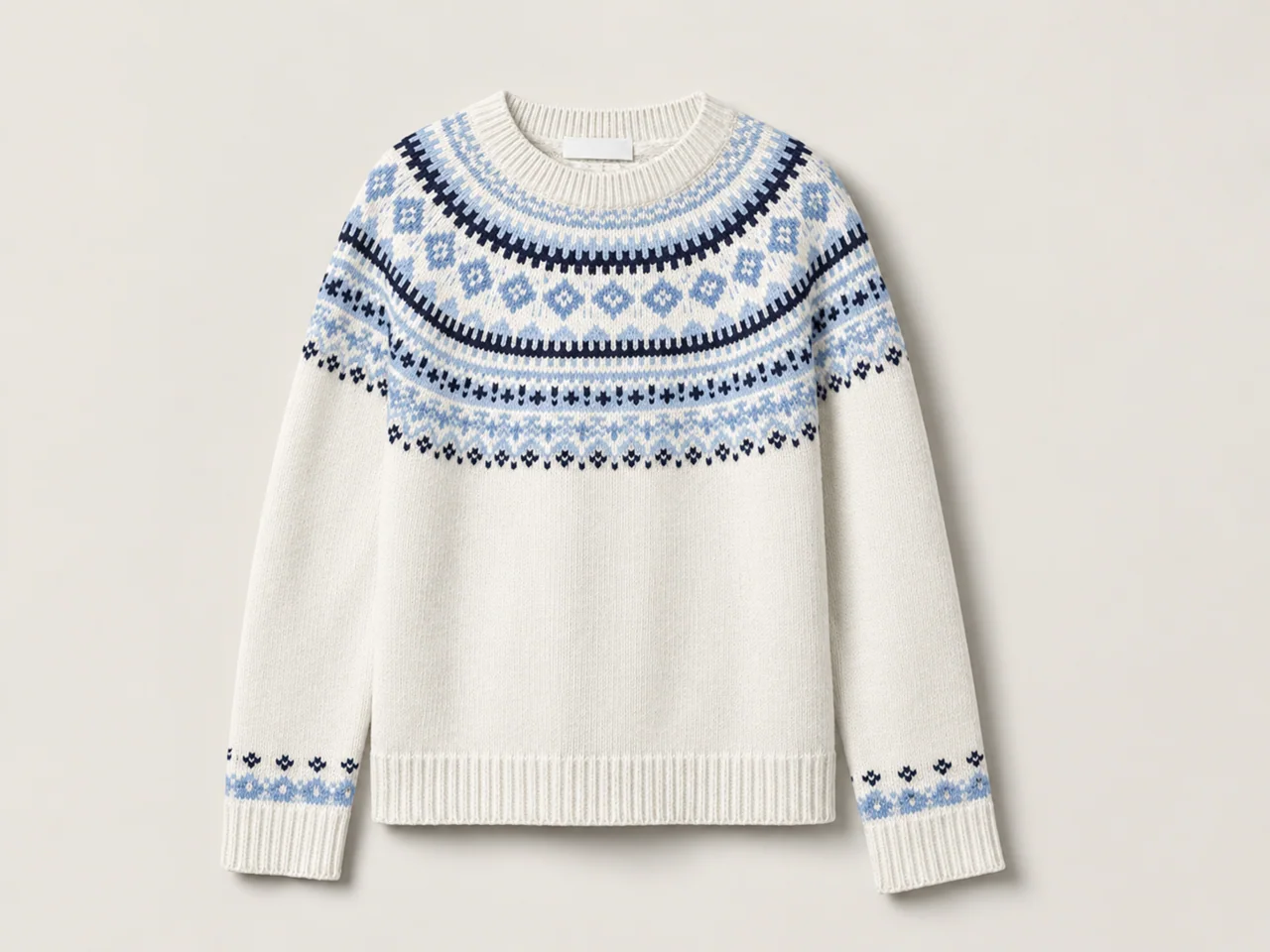
Traditional Fair Isle knitwear is recognised for its repeating geometric patterns, carefully balanced colour combinations and distinctive stranded knitting construction. Developing a modern Fair Isle sweater requires more than reproducing a traditional pattern. The colour arrangement, stitch structure, yarn tension and reverse-side construction all need to work together.
This VIAKNIT development case study focuses on a women's 7GG Fair Isle sweater made from 100% wool. Inspired by traditional Nordic knitwear, the design combines ivory white, soft powder blue, navy and light grey to create a cleaner, more contemporary interpretation of classic geometric colourwork.
The development involved adapting the original colour arrangement, translating the pattern into machine-knittable instructions, controlling reverse-side yarn floats and evaluating the behaviour of wool during knitting and finishing.
For this type of sweater, the appearance of the front pattern is only one part of the development. The reverse-side construction, fabric density, colour consistency and dimensional stability are equally important to the finished garment.
Project Background: Traditional Fair Isle Meets Modern Nordic Knitwear
Nordic knitwear has a strong connection with traditional knitting techniques and practical everyday clothing. Fair Isle patterns are particularly recognisable for their repeating geometric motifs and coordinated use of multiple colours.
For this project, the designer wanted to retain the traditional Fair Isle character while introducing a fresher colour direction.
The original design concept was developed around a combination of white and powder blue, with navy and light grey providing additional contrast.
The development focus was on three main objectives.
Preserving the Fair Isle Pattern Structure
The repeating geometric motifs needed to remain continuous across the upper body and shoulders, with a natural visual transition around the neckline and upper sleeves.
Refining the Colour Arrangement
The original white and light blue colour relationship was adjusted to create an ivory-white main background with powder-blue pattern sections. Navy and light grey were retained as additional colours.
This was not simply a digital colour replacement. The pattern proportions, contrast and yarn arrangement needed to be reconsidered together.
Developing the Design in 7GG Pure Wool Knitwear
The sweater needed to retain the substantial character associated with traditional wool knitwear without becoming unnecessarily heavy or dense.
The 7GG knitting construction provided the development foundation, while yarn selection, stitch density and finishing remained important factors in determining the final fabric characteristics.
Design Requirements and Material Specifications
The project specifications were established around the following requirements.
| Specification | Project Details |
|---|---|
| Product | Women's Fair Isle Sweater |
| Fibre Composition | 100% Wool |
| Machine Gauge | 7GG |
| Main Colour | Ivory White |
| Contrast Colour | Soft Powder Blue |
| Additional Colours | Navy / Light Grey |
| Main Construction | Fair Isle Stranded Colourwork |
| Pattern Style | Repeating Geometric Motifs |
| Neckline | Crew Neck |
| Cuffs and Hem | Ribbed Cuffs and Hem |
| Main Design Feature | Multi-Colour Pattern Across the Upper Body and Shoulders |
The yarn specification and finished garment weight need to be confirmed against the actual approved material and sample records.
For wool knitwear, fibre composition alone does not determine the final fabric thickness, softness or weight. Yarn count, spinning structure, knitting density and finishing conditions also influence the result.
The colour selection is equally important. Physical yarn shades should be reviewed rather than relying entirely on digital artwork, because the appearance of a colour can change when it is knitted together with other yarns.
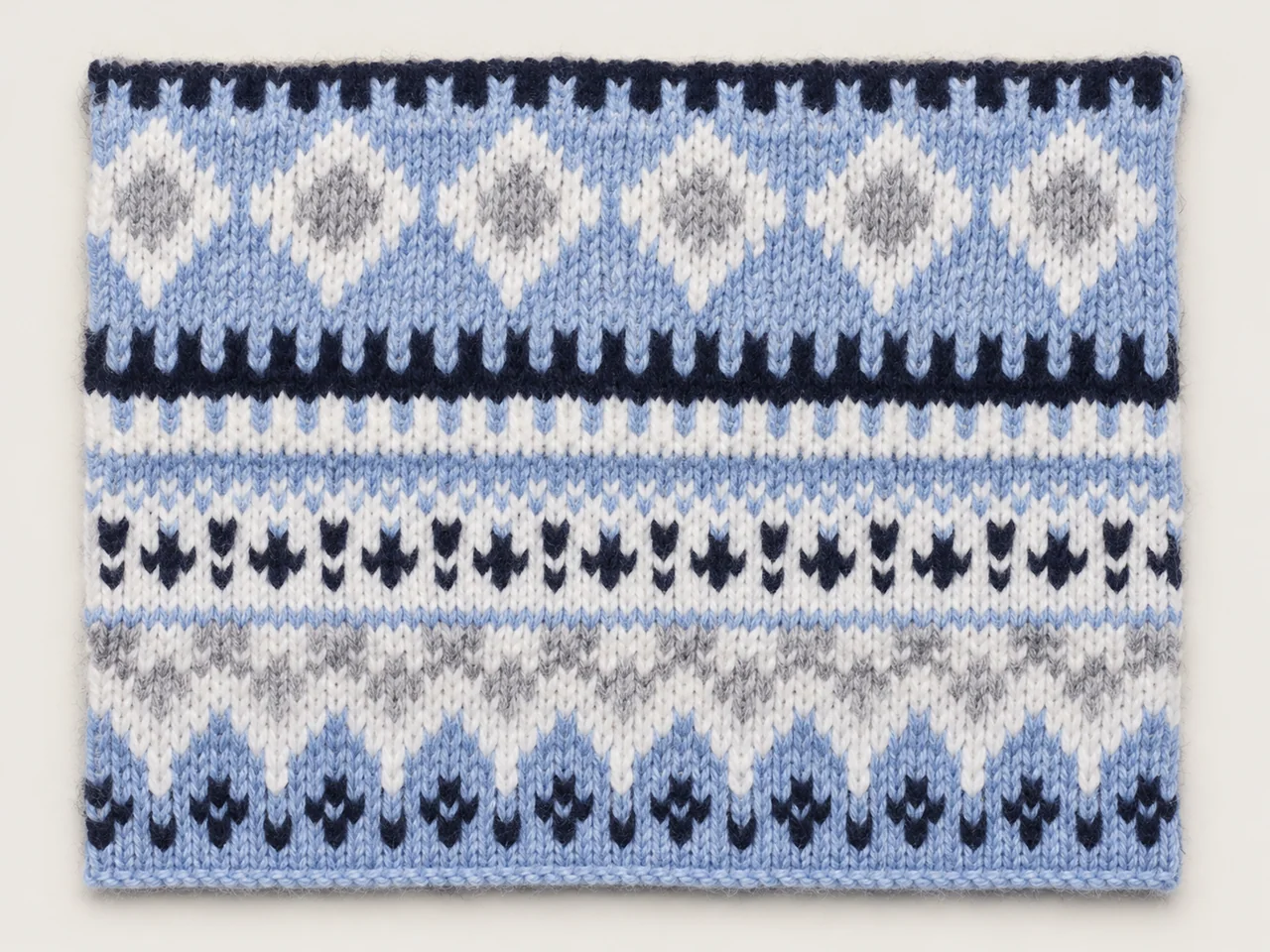
Six Technical Challenges in Fair Isle Sweater Development
3.1 Maintaining Accurate Multi-Colour Pattern Alignment
Fair Isle colourwork relies on repeating motifs and carefully arranged colour sections.
Even a small error in the pattern repeat or colour sequence can affect the appearance of the entire design, particularly around the chest and shoulder area.
The original artwork therefore needs to be translated into machine-knittable pattern instructions before the complete garment is developed.
For this project, the main considerations included horizontal pattern repeats, vertical row alignment, colour transitions and the relationship between the motifs and the garment shape.
We recommend developing representative jacquard swatches before proceeding with the complete sweater.
This allows the team to assess the colour arrangement, motif proportions and pattern continuity in actual knitted fabric rather than relying only on the digital design.
3.2 Controlling Yarn Floats on the Reverse Side
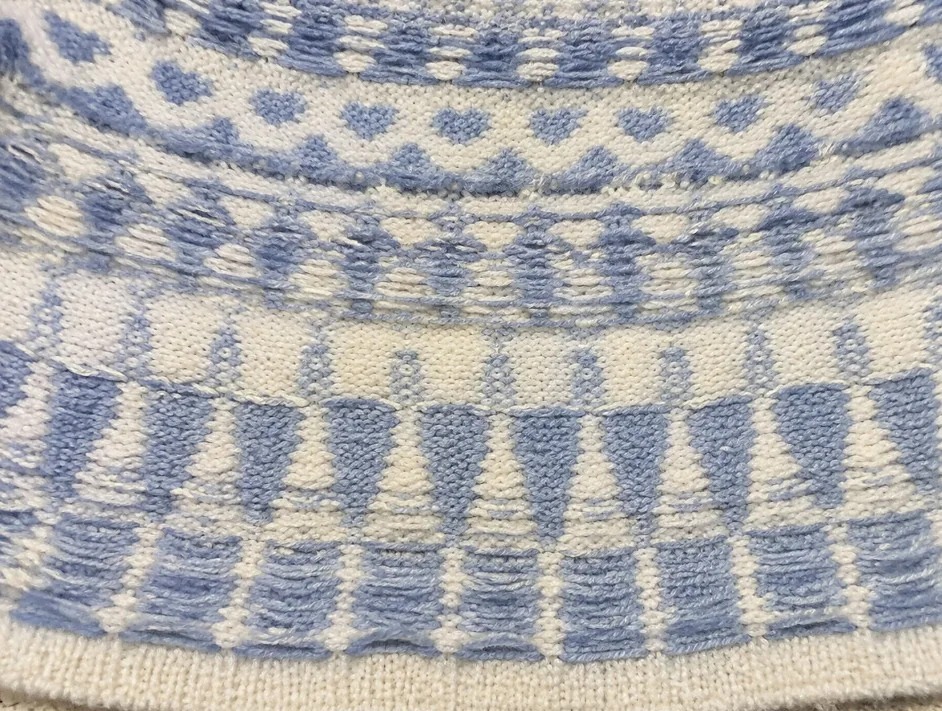
One of the most important technical aspects of stranded Fair Isle knitting is the management of unused yarns on the reverse side.
When multiple colours are used in the same row, the yarn not currently being knitted may travel behind the active stitches as a float.
If a float is too long, it can catch on fingers or other clothing during wear.
If the floats are pulled too tightly, they can restrict the fabric, causing puckering or distortion on the front side.
The technical team needs to evaluate float length, yarn tension and the way unused yarns are managed across different pattern sections.
Where necessary, the pattern construction or float-management approach should be adjusted according to the design.
For this reason, examining the reverse side of a Fair Isle sweater is just as important as reviewing the front pattern.
The reverse-side construction provides useful information about knitting quality and the practical wearing characteristics of the garment.
3.3 Managing Yarn Tension in 100% Wool at 7GG
Pure wool yarn has natural elasticity, but its behaviour during knitting depends on yarn count, twist, spinning structure and processing characteristics.
At 7GG, the relationship between yarn tension and stitch density has a direct influence on fabric appearance and hand feel.
If the fabric is too loose, the pattern may lack definition and the structure may feel unstable.
If the fabric is too tight, the garment may become unnecessarily dense and the pattern can lose its intended appearance.
Representative knitting swatches should therefore be used to compare yarn tension, stitch density and fabric hand feel.
The objective is to establish a balanced construction that allows the Fair Isle pattern to remain clear while maintaining the intended character of the wool garment.
3.4 Maintaining Pattern Clarity After Colour Reversal
Changing the relationship between the original white and powder-blue colours introduces additional development considerations.
A colour combination that looks balanced in digital artwork may produce a different visual effect once knitted.
The contrast between the main background and the pattern colours needs to remain clear, particularly around smaller geometric motifs.
For this project, attention was given to the visibility of powder-blue motifs against the ivory-white background, together with the definition of navy pattern details.
The curved shoulder area also requires careful review because the pattern must remain visually continuous as it follows the garment construction.
Physical colour swatches and knitted pattern samples provide a more reliable basis for colour approval than screen images alone.
3.5 Controlling Wool Garment Dimensions and Surface Appearance After Washing
Wool knitwear can change during washing and finishing.
Depending on the wool characteristics and processing conditions, the fabric may relax, change dimensions or develop surface felting.
For this reason, an unwashed swatch is not sufficient for determining the final garment measurements.
The relevant washing and care conditions should be evaluated using the actual yarn and knitted construction.
Measurements such as body length, chest width and sleeve length should be recorded before and after the agreed washing process.
The fabric surface should also be checked for changes in appearance and pilling.
The purpose is to establish the finished fabric dimensions and appearance before confirming the final garment specifications.
3.6 Maintaining Colour and Pattern Consistency During Bulk Production
A knitted sample can be individually adjusted to achieve the desired appearance. Bulk production requires those specifications to be repeated consistently across garments and production batches.
For multi-colour wool knitwear, important control points include yarn colour batches, knitting programme versions, stitch density and pattern alignment.
The approved knitted swatch, physical yarn colour references, pattern programme and garment measurement specifications should be retained as production references.
Initial production checks should focus on colour appearance and pattern density so that any variation can be identified early.
This helps the production team maintain a consistent reference rather than waiting until the entire order has been completed before identifying problems.
VIAKNIT’s Development Process and Production Preparation
For custom Fair Isle knitwear, we recommend a six-stage development process.
Stage 1 — Design and Technical File Review
Review the original artwork, pattern repeats, colour count, neckline construction, sleeve pattern placement and garment measurements.
The design needs to be translated into technical information suitable for knitting programming.
Particular attention should be given to the continuity of the motifs around the upper body and shoulders.
Stage 2 — Yarn and Colour Approval
Select suitable 100% wool yarn for the 7GG knitting construction.
Develop the proposed colour combination using ivory white, powder blue, navy and light grey.
Physical yarn colour cards should be prepared for approval. Screen colours alone are not a reliable reference for final knitted colour appearance.
Stage 3 — Fair Isle Swatch Development
Develop representative chest and shoulder pattern swatches.
The main review points include motif definition, colour transitions, stitch uniformity, reverse-side floats and any visible fabric puckering.
Both sides of the swatch should be examined before the complete garment is developed.
Stage 4 — Complete Garment Sampling
Develop the complete sweater, including the body, sleeves, crew neckline, cuffs and hem.
The finished sample should be reviewed on a mannequin to assess how the Fair Isle pattern travels around the shoulders and connects visually across the front, back and upper sleeves.
Stage 5 — Washing and Dimensional Evaluation
Evaluate the wool garment according to the intended care and finishing requirements.
Observe fabric relaxation, dimensional changes and surface appearance.
The garment measurements and finishing specifications can then be reviewed against the intended fit.
Stage 6 — PP Sample and Bulk Production
After the sample revisions, prepare a pre-production sample using the yarn and construction intended for bulk production.
The PP sample, colour references and relevant technical specifications should be approved before proceeding with the order.
This provides a clear reference for the production team and helps maintain consistency between development and manufacturing.
VIAKNIT's Key Technical Decisions
Four decisions are particularly important in this project.
Why Use 7GG for a Pure Wool Fair Isle Sweater?
7GG provides a relatively substantial knitting structure that suits the traditional character of wool Fair Isle knitwear.
It allows the geometric colourwork to be developed within a fabric structure that has more visual substance than many finer-gauge constructions.
However, gauge alone does not determine garment thickness or weight. Yarn count, stitch density, knitting construction and finishing must also be considered.
Why Use Ivory White as the Main Colour?
Using ivory white as the main background, with powder blue, navy and light grey as contrast colours, creates a cleaner interpretation of traditional Nordic geometric patterns.
The colour arrangement helps the upper-body motifs stand out while maintaining a coordinated appearance across the garment.
The actual yarn colours need to be reviewed in knitted form to ensure that the intended contrast is achieved.
Why Is Reverse-Side Float Management So Important?
A well-defined Fair Isle pattern on the front does not automatically mean the construction is complete.
Long or excessively tight floats can affect wearing comfort and fabric appearance.
We therefore consider reverse-side float length, arrangement and tension as part of the pattern development process, particularly around the underarm, shoulders and sleeve connection areas.
Why Should Washed Fabric Dimensions Determine Final Measurements?
Natural wool relaxation and washing behaviour can influence the final garment shape.
The finished measurements should therefore be based on the confirmed fabric and finishing condition rather than the dimensions immediately after knitting.
This is particularly important when preparing production specifications for wool sweaters.
Quality Control and Technical Verification
For a multi-colour 7GG wool sweater, quality assessment should cover the yarn, knitted pattern, reverse-side construction and finished garment.
| Inspection Area | Verification Method |
|---|---|
| Fibre Composition | Yarn supplier documentation or fibre composition testing |
| Pattern Accuracy | Comparison with approved knitted swatches |
| Reverse-Side Floats | Visual inspection and practical wearing assessment |
| Dimensional Stability | Before-and-after washing measurements |
| Pilling Performance | Appropriate wool knitwear testing method |
| Finished Garment Weight | Actual garment weighing |
| Colour Consistency | Comparison with approved physical yarn colour references and batch records |
The technical records for this project should distinguish between confirmed specifications and measurements that still require actual verification.
| Technical Data | Project Record |
|---|---|
| Fibre Composition | 100% Wool |
| Machine Gauge | 7GG |
| Yarn Count | To be confirmed |
| Finished Weight | To be measured |
| Stitch Construction | Fair Isle Stranded Colourwork |
| Main Colour | Ivory White |
| Contrast Colour | Powder Blue |
| Additional Colours | Navy / Light Grey |
For production approval, the relevant yarn count, fabric density, finished weight and washing performance should be recorded against the approved sample.
What Designers Should Consider When Developing Custom Fair Isle Knitwear
A successful Fair Isle sweater requires a balance between traditional pattern design and modern manufacturing requirements.
Before starting development, designers should consider the number of colours, pattern repeat, motif size, garment gauge, yarn characteristics and the intended fit.
The colour combination also needs to be evaluated in knitted form because digital artwork cannot fully represent how different yarn shades interact within a stranded colourwork structure.
For more complex designs, representative pattern swatches should be approved before complete garment sampling.
Designers should also pay attention to the reverse side of the fabric. Float length and tension can influence both comfort and the appearance of the knitted garment.
If the project starts with a reference image rather than a complete Tech Pack, the development process can begin with an artwork review and technical discussion.
This allows the knitting team to identify pattern requirements and suitable construction options before moving into sampling.
Technical Questions
Can a 7GG machine produce traditional Fair Isle patterns?
Yes. A suitable 7GG knitting machine can be used to develop stranded colourwork patterns, subject to the machine's technical capabilities, yarn specifications and pattern requirements.
The final fabric appearance depends on yarn count, stitch density, colour arrangement and knitting tension.
Representative swatches should be developed to confirm the intended construction before complete garment sampling.
How do manufacturers control yarn floats on the reverse side?
Manufacturers evaluate float length, yarn tension and pattern construction during swatch development.
Excessively long floats may catch during wear, while floats that are too tight can cause fabric puckering and restrict the stretch of the knitted structure.
The reverse side should be inspected alongside the front pattern to confirm that the construction is suitable for the intended garment.
How do manufacturers maintain pattern alignment across garment panels?
Pattern alignment begins with accurate knitting programming and consistent pattern repeat specifications.
The body and sleeves need to be reviewed against the approved pattern reference, with attention to motif placement and the relationship between adjoining garment sections.
Knitted swatches and the complete sample provide references for checking the visual continuity of the pattern.
Related Expertise
14GG Ski-Themed Intarsia Sweater Development ↗
Discuss Your Project