
Case Study CS08 · Hybrid outerwear
7GG Hybrid Down Knit Cardigan Development
Reviewed by VIAKNIT Technical Development Team
Join quilted down panels to wool knit sleeves while refining the zipper, pockets and lining.
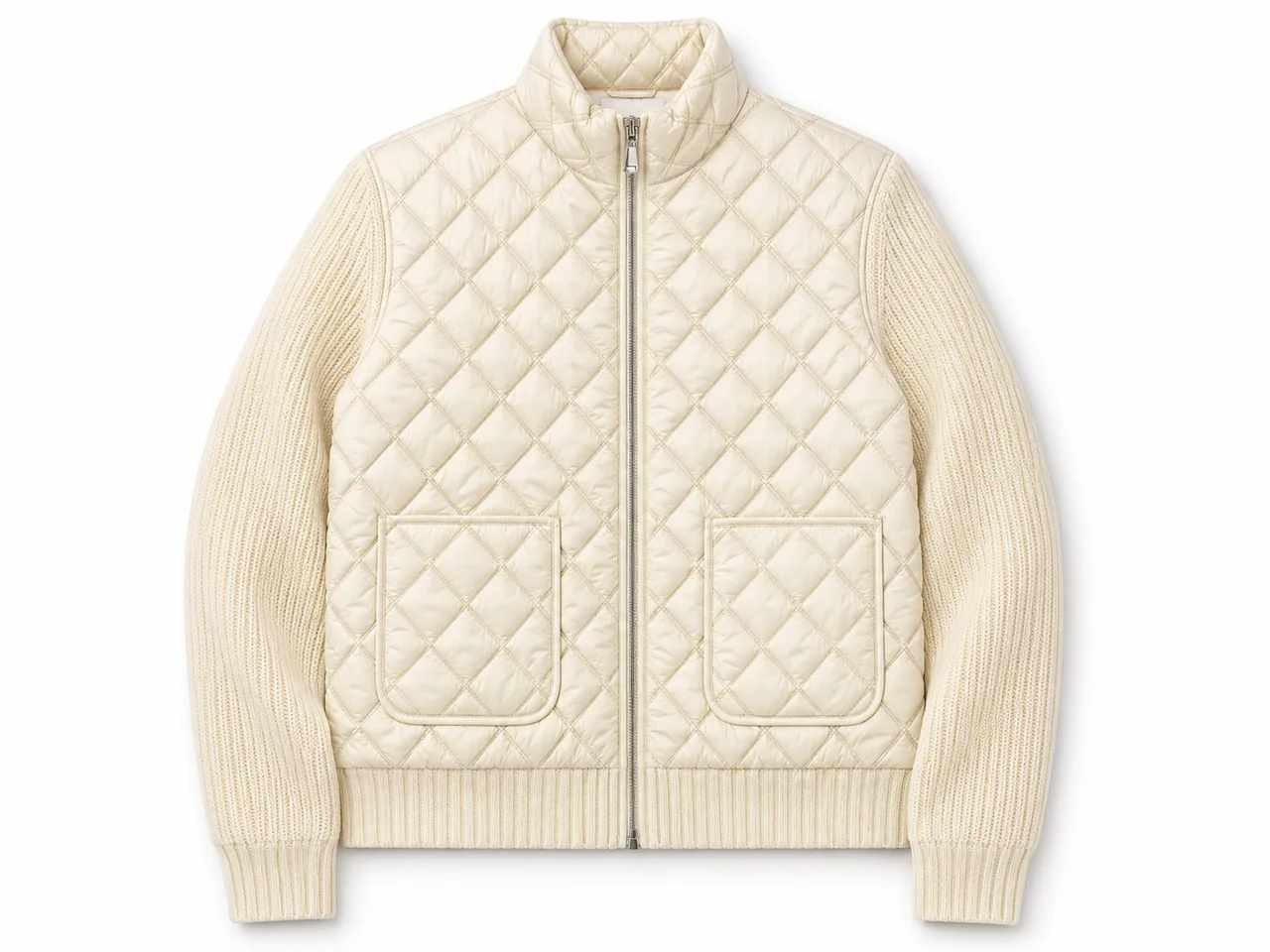
Combining a quilted down jacket body with wool knitted sleeves creates a distinctive hybrid garment, bringing together the insulation structure of padded outerwear and the softness of traditional knitwear.
However, developing this type of garment requires more than combining two different materials. The knitted and down-filled sections behave differently in terms of thickness, elasticity, dimensional stability and construction. Their joining points, pocket positions, front zipper and lining all need to work together to achieve a balanced finished garment.
This case study documents the development of a hybrid down knit cardigan.
The garment combines a quilted down-filled woven front and back body with 7GG wool knitted sleeves. Diamond quilting creates the characteristic padded appearance, while 2×1 rib cuffs and hem provide a more familiar knitwear finish.
The design also incorporates a knitted collar, a centre-front metal zipper and large functional pockets on both sides.
During development, the designer identified several specific construction issues, including uneven pocket angles, tension around the centre-front zipper, collar height requirements and lining positioning.
These were not simply cosmetic adjustments. They involved garment measurements, material integration and the coordination of different manufacturing processes.
For VIAKNIT, the project required the technical development of knitted components, coordination with the down garment construction process, sample revisions and preparation for bulk production.
Project Background: A Hybrid Between Down Outerwear and Wool Knitwear
The project originated from an independent design team looking to develop a distinctive autumn/winter garment.
Rather than creating a conventional wool cardigan or a standard padded jacket, the designer wanted to combine the warmth and three-dimensional appearance of quilted outerwear with the softer wearing experience of knitted sleeves.
The design was built around three main elements.
Quilted Down-Filled Body
The front and back body use a diamond-quilted down-filled construction. The diamond pattern creates a structured appearance while accommodating the insulation filling.
The quilting needs to remain visually consistent, with balanced filling distribution and no obvious distortion or uneven bulging.
7GG Wool Knitted Sleeves
The sleeves use 7GG wool knit construction, providing a softer and more flexible alternative to conventional woven outerwear sleeves.
The cuffs and hem use single-layer 2×1 rib construction, with attention to stretch and recovery.
The original technical specification also identifies pique stitch structures and related jacquard details in selected sleeve and collar areas. These details need to follow the approved knitting programme and confirmed sample.
Functional Garment Construction
The design includes a centre-front metal zipper, large functional pockets on both sides, an integrated collar, lining and brand identification details.
The overall direction is Contemporary Luxury Casual, combining the appearance of premium padded outerwear with the comfort of knitwear.
The main development challenge was to ensure that the different components could function as one coordinated garment, rather than looking like separate materials simply sewn together.
Product Specifications and Technical Requirements
The customer provided design references and a detailed Tech Pack covering four sizes: 34, 36, 38 and 40.
The technical requirements included measurements, colours, pocket construction, zipper positioning, collar dimensions, lining and branding locations.
The project specifications can be summarised as follows.
| Specification | Project Details |
|---|---|
| Product | Hybrid Down Knit Cardigan |
| Size Range | 34 / 36 / 38 / 40 |
| Knitted Sleeve Gauge | 7GG |
| Knitted Sleeve Material | Wool |
| Sleeve Construction | 7GG Knitted Structure |
| Cuffs and Hem | Single-Layer 2×1 Rib |
| Main Body | Quilted Down-Filled Woven Panels |
| Quilting Pattern | Diamond Quilting |
| Front Closure | Centre-Front Metal Zipper |
| Pockets | Two Large Functional Pockets |
| Collar | Combined Woven and Knitted Construction |
| Inner Construction | Lining with Eight Positioning Points |
The product was divided into three main manufacturing modules.
A. Down-Filled Body
The front and back body use diamond quilting with down filling.
The quilting lines need to remain aligned and visually consistent. Filling distribution also needs to be controlled to avoid noticeable differences in thickness between sections.
B. 7GG Wool Knitted Components
The sleeves use 7GG wool knitting, with 2×1 single-layer rib at the cuffs and hem.
The technical file also includes pique and jacquard-related details in selected areas, which must follow the approved machine programme and sample.
The sleeve measurements, fabric density, elasticity and rib recovery need to be evaluated across all four sizes.
C. Lining and Garment Accessories
The internal construction includes lining, front zipper, left and right pockets, collar connections, positioning points and brand labels.
One important consideration is that the down-filled body and knitted sleeves have different thicknesses and elasticity.
Their connection therefore needs to be developed with attention to seam construction, material tension and the movement required during wear.
Five Technical Challenges in Hybrid Down Knitwear Development
3.1 Connecting Quilted Down Panels with 7GG Wool Knitted Sleeves
The first and most important challenge is the connection between the down-filled body and knitted sleeves.
The quilted woven body is relatively stable, while the 7GG wool knitted sleeves have greater natural elasticity.
If the armhole dimensions, joining lengths or knitting tension are not properly coordinated, the finished garment may develop puckering, pulling or uneven sleeve positioning.
The problem can become more noticeable during wear because the knitted sleeve needs to accommodate arm movement while the padded body maintains a more structured shape.
Our development approach is to evaluate the knitted sleeve and down-filled body together rather than treating them as completely separate components.
Particular attention is given to armhole measurements, shoulder construction, joining length and the relationship between the knitted fabric's elasticity and the more stable woven body.
The objective is to create a balanced connection that allows the sleeves to move naturally without distorting the padded body.
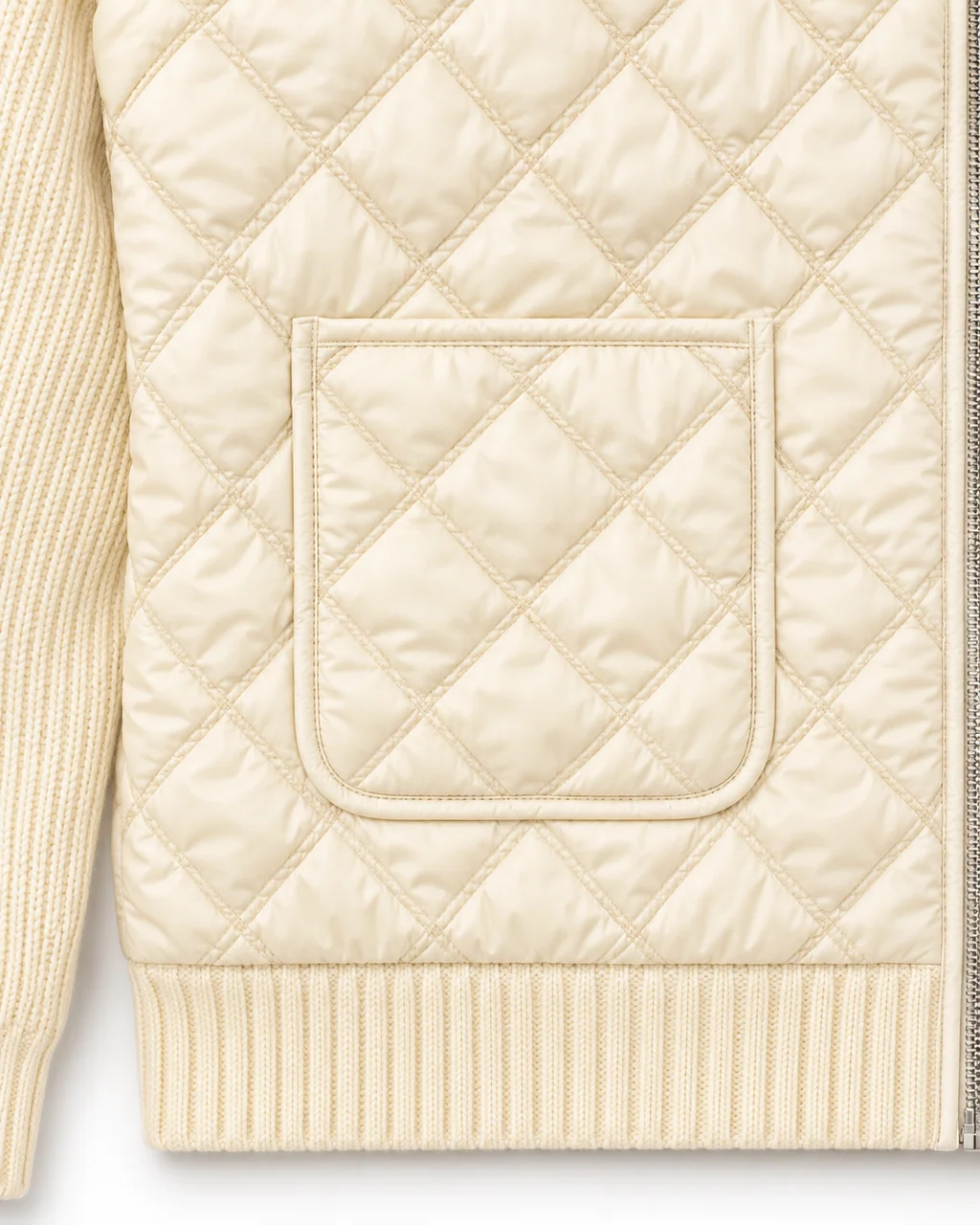
3.2 Aligning Diamond Quilting with Pocket Positioning
The large functional pockets are an important part of the garment design.
Their positioning needs to work visually with the diamond quilting while remaining practical for everyday use.
During sample review, the designer specifically identified that the left and right pocket angles were inconsistent.
This required more than simply adjusting the pocket measurements.
The pocket height, angle, distance from the centre-front zipper and relationship with the surrounding quilting pattern all needed to be reviewed together.
The approved pocket-to-zipper distances were specified separately for each size.
| Size | Pocket-to-Zipper Distance |
|---|---|
| 34 | 5.0 cm |
| 36 | 5.5 cm |
| 38 | 6.0 cm |
| 40 | 6.5 cm |
These measurements demonstrate why hybrid garment development requires size-specific construction references.
A pocket position that works visually on one size cannot automatically be applied to every other size.
Our approach is to use the approved Tech Pack and physical garment measurements together, checking both pocket angles and left-right symmetry on the complete garment.
3.3 Preventing Waves and Distortion Around the Centre-Front Zipper
The designer also identified pulling around the centre-front zipper during sample review.
A zipper installed into a garment combining padded woven panels and knitted components needs to be carefully controlled.
Differences in material thickness, feeding and sewing tension can influence the finished front opening.
If the two sides are not aligned correctly, the zipper area may develop waviness or uneven tension.
Our technical review focuses on the relationship between zipper tape, front panel alignment, sewing tension and the surrounding garment structure.
The zipper should be checked not only when the garment is laid flat but also when it is worn and naturally positioned.
The objective is to maintain a straight front opening, balanced tension on both sides and smooth zipper operation.
The customer also requested a change to the original chest reinforcement construction.
The previous solution was replaced with a 2.5 cm wide knitted tape construction covering the relevant zipper area.
This modification needed to be incorporated into the final garment construction specifications so that the revised detail could be reproduced consistently.
3.4 Controlling Different Front and Back Collar Heights
The collar construction required separate measurements for the front and back.
The original Tech Pack specified the following dimensions.
| Collar Area | Woven Fabric Section | Knitted Section | Total Height |
|---|---|---|---|
| Front Collar | 5.0 cm | 1.5 cm | 6.5 cm |
| Back Collar | 4.0 cm | 1.5 cm | 5.5 cm |
The front collar is therefore 1 cm higher than the back collar.
These dimensions cannot be treated as one uniform collar measurement.
The relationship between the woven and knitted sections also needs to be maintained during construction.
If the front and back collar heights are not controlled separately, the finished neckline may not follow the intended shape.
The collar should therefore be measured and checked against the approved technical specifications before final garment assembly.
3.5 Maintaining Accurate Lining Positioning and Internal Construction
The designer required eight positioning points between the lining and outer garment.
These points covered the relevant side areas, shoulder tops, lower armhole areas and sleeve sections.
This is an important detail because the lining and outer garment have different material structures and may behave differently during movement.
If the lining is not correctly positioned, it may twist, accumulate excess fabric or restrict the garment during wear.
Our development approach is to establish the positioning references in the technical file and ensure that the lining is secured at the required locations.
The lining should remain properly aligned with the outer garment without creating unnecessary internal tension.
The finished garment needs to be inspected both inside and outside because internal construction problems may not be visible during a simple front-view inspection.
VIAKNIT’s Development Process and Production Preparation
This project required coordination between knitwear production, padded garment construction, accessories and finishing.
The development process was organised into five main stages.
Stage 1 — Technical File Review and Product Breakdown
After receiving the customer's Tech Pack, the development team reviewed the size chart, material specifications, knitting structures, pocket dimensions, zipper position and lining requirements.
The customer's sample comments were also organised as separate technical revision items.
This was important because modification requirements should be incorporated into the working specifications rather than remaining only in photographs or email conversations.
The garment was divided into its knitted, down-filled and internal construction components to establish the manufacturing requirements for each section.
Stage 2 — 7GG Wool Knitted Sleeve Development
The next stage focused on the wool knitted sleeves.
The 7GG knitting structure and yarn direction were reviewed, followed by representative knitted swatches.
The main evaluation points included fabric density, hand feel, elasticity and rib recovery.
Sleeve length, sleeve width and cuff dimensions needed to be adjusted across sizes 34, 36, 38 and 40.
The 2×1 single-layer rib cuffs and hem also required attention to ensure that the finished garment maintained the intended stretch and shape.
Stage 3 — Integration of the Down-Filled Body and Knitted Components
This was the most important stage of the project.
The down-filled body needed to be developed with its quilting, pockets and zipper construction, while the knitted components required their own sleeve, collar and rib specifications.
Once both sections were prepared, their connections needed to be evaluated.
The main review areas included armholes, shoulders, hem connections and the structural relationship around the centre-front zipper.
The objective was to ensure that the two different manufacturing systems could be integrated into one balanced garment.
Stage 4 — Sample Revisions Based on Customer Comments
The customer's technical comments identified several specific revisions.
The centre-front zipper pulling and inconsistent pocket angles needed to be corrected.
The original chest reinforcement construction was to be replaced by a 2.5 cm wide knitted tape covering the relevant zipper area.
Pocket-to-zipper distances needed to follow the separate measurements for each size.
Front and back collar heights required individual control.
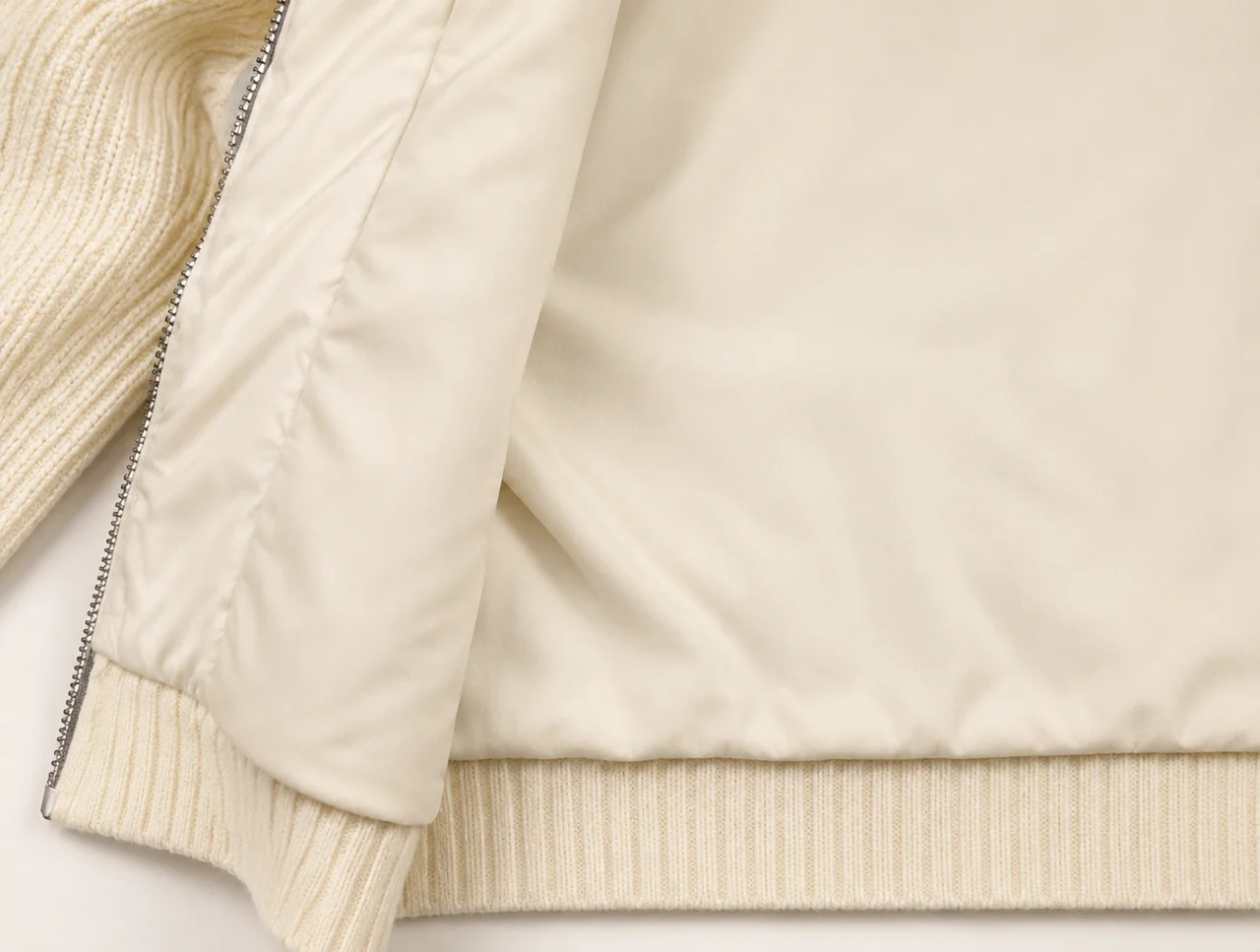
The lining and outer garment needed to be secured at eight positioning points.
The front collar, collar underside and size label positions also needed to follow the customer's revised instructions.
These were structural and measurement-related revisions, not simply visual adjustments.
Each item needed to be reflected in the updated sample specifications and production references.
Stage 5 — Sample Approval and Production Preparation
Following sample approval, the final Tech Pack, size chart, colour references, yarn information, zipper specifications, pocket measurements and manufacturing instructions needed to be consolidated.
For a hybrid garment, it is particularly important that the knitting team and padded garment production team work from the same approved technical information.
Different departments should not interpret the same design independently.
An approved sample and technical specifications should provide the common reference for production.
This approach helps maintain consistency between the knitted components, down-filled body, accessories and final garment assembly.
VIAKNIT's Key Technical Decisions
Several decisions were particularly important in this project.
Why Use 7GG Wool Knitted Sleeves?
7GG provides a relatively substantial knitting structure suitable for the intended wool sleeve design.
However, machine gauge alone does not determine fabric thickness, weight or elasticity.
Different yarn counts, machine tension, stitch structures and finishing conditions can produce different results even at the same gauge.
For this reason, the actual knitted swatch and approved garment sample should remain the primary references.
Why Establish Separate Construction Standards for Knit-to-Down Connections?
The knitted sleeves, padded body and ribbed hem have different material characteristics.
Their joining areas therefore need their own construction references.
The armhole, hem and collar connections should have clearly defined joining methods, positioning lengths and acceptable tolerances.
This helps reduce variation between different production batches.
Why Check Pockets and Zipper Together?
Pocket measurements cannot be evaluated independently from the front zipper and surrounding diamond quilting.
The approved size specifications demonstrate this clearly.
The pocket-to-zipper distance changes from 5.0 cm in size 34 to 6.5 cm in size 40.
The final inspection should therefore include both the actual measurements and the visual balance of the complete garment.
Why Record Lining Positioning Points?
The eight positioning points help maintain the relationship between the lining and outer garment.
This is particularly important for garments combining a relatively stable padded body with knitted sleeves.
Accurate internal positioning helps reduce twisting and unnecessary fabric accumulation.
Quality Control for Hybrid Down Knitwear Production
Quality control for a hybrid garment order needs to cover the knitted components, down-filled body, garment assembly and finished product.
We organise the main inspection requirements into three stages.
In-Process Inspection
During production, the knitted sleeves, quilted body, pockets, zipper and joining operations should be checked.
The aim is to identify construction problems while the relevant components are still accessible for correction.
Inline Measurement
Measurements should be checked across sizes 34, 36, 38 and 40.
The main measurement points include garment length, chest, shoulder width, sleeve length and pocket positioning.
The approved pocket-to-zipper distances should be used as specific references.
Final Inspection
The finished garment should be inspected for left-right symmetry, zipper operation, quilting appearance, loose threads, lining construction, garment measurements and packaging.
For down-filled products, additional material and filling checks are also important.
Depending on the filling specification, relevant evaluation areas include filling composition, filling weight, cleanliness, loft and down leakage performance.
Filling weight should be recorded according to the relevant garment sections when required by the product specification.
Down leakage can also be influenced by the shell fabric, stitching and construction, rather than the filling material alone.
For this reason, down-related quality checks should be considered together with the garment's actual construction.
The approved sample and technical specifications provide the basis for production inspection and final acceptance.
What Designers Should Consider Before Developing a Hybrid Down Knit Cardigan
A hybrid down knit cardigan requires early coordination between the knitted components and the padded outerwear structure.
Before development begins, designers should consider the following technical areas.
Knitted Component Specifications
The yarn composition, gauge, stitch construction, sleeve measurements and rib details should be clearly defined.
Down-Filled Body Construction
The quilting pattern, filling specification, pocket design and shell material need to be established.
Material Integration
The armhole, shoulder, collar and hem connections should be reviewed to account for differences in thickness and elasticity.
Zipper and Pocket Positioning
The front opening and pocket measurements should be coordinated with the quilting layout and garment size specifications.
Lining and Internal Construction
The lining attachment points and internal positioning requirements should be included in the Tech Pack.
Size Grading
Measurements and construction details should be checked across the full size range rather than developed from one sample size alone.
For designers working from an initial sketch or reference garment, the development process can begin with a technical review of the design and its component materials.
This allows the manufacturing team to identify the main construction requirements before proceeding with sample development.
Technical Questions
How do manufacturers join knitted panels and padded sections?
The joining method depends on the thickness, elasticity and construction of the two materials.
For a garment with 7GG wool knitted sleeves and quilted down-filled body panels, particular attention should be given to armhole measurements, seam construction, shoulder connections and joining tension.
Representative sample development helps establish a suitable construction before bulk production.
How do you prevent down leakage in hybrid knitwear?
Down leakage needs to be controlled through suitable shell fabric, quilting construction, seam design and sewing quality.
The filling material and filling distribution should also be considered.
Particular attention should be given to stitching areas and panel connections, where down may escape if the construction is unsuitable.
The final garment should be evaluated for visible filling leakage under the agreed quality requirements.
How do you maintain the shape of knitted panels next to padded sections?
The knitted panels need to be developed with suitable yarn, stitch density and finishing conditions.
Their joining dimensions should also be coordinated with the more stable padded sections.
For hybrid garments, the relationship between sleeve elasticity, armhole construction and overall garment measurements is particularly important.
The approved sample provides the reference for maintaining consistent construction.
Related Expertise
14GG Knit-and-Woven Hybrid Top Development ↗
Discuss Your Project