
Case Study CS07 · Placement printing
14GG Cashmere Digital Print Sweater Development
Reviewed by VIAKNIT Technical Development Team
Position detailed artwork on fine-gauge cashmere while accounting for surface halo and hand feel.
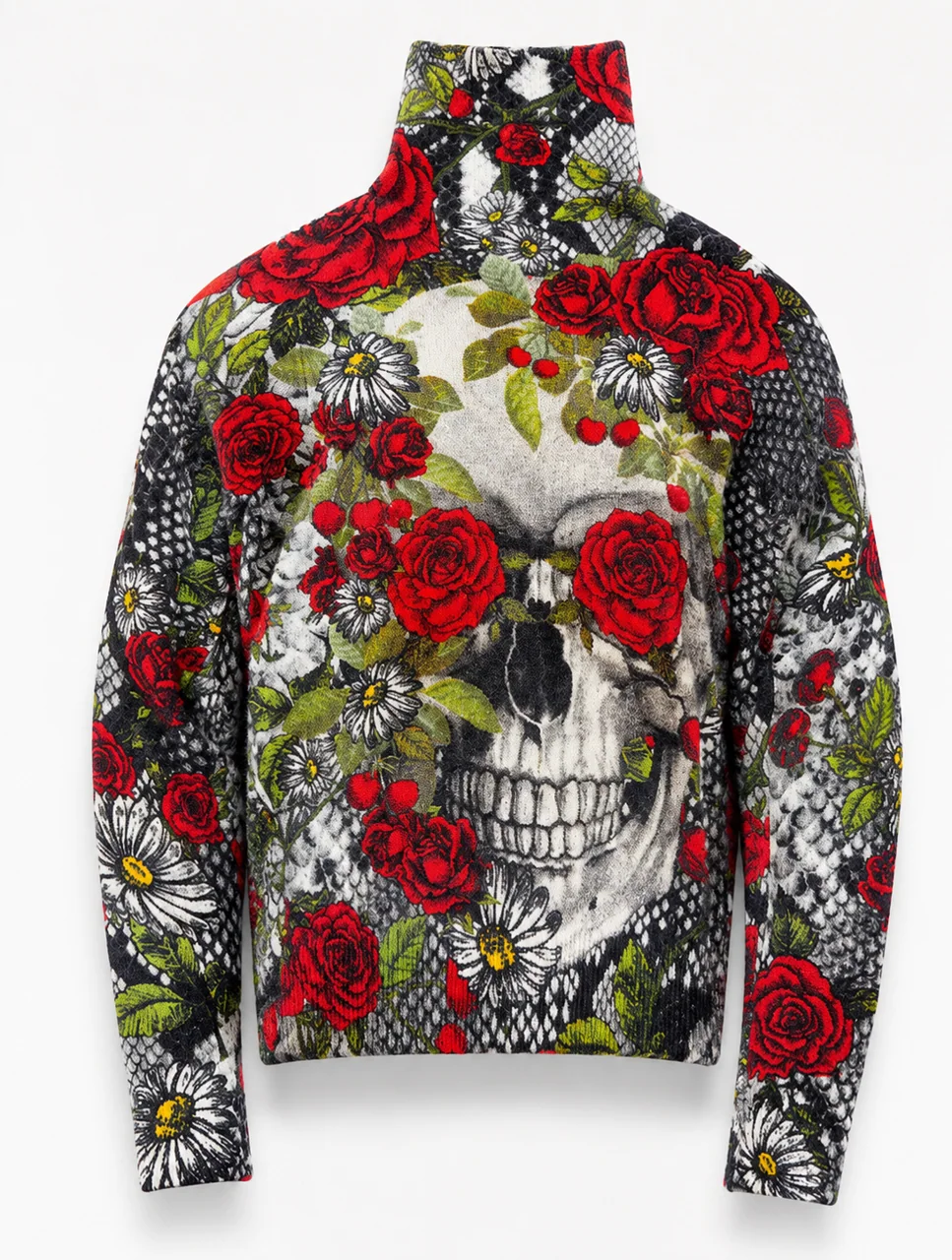
Developing a digitally printed cashmere sweater requires more than transferring an image onto knitted fabric. The printing process must work with the natural characteristics of cashmere while maintaining colour definition, fabric softness, garment dimensions and the intended visual placement of the artwork.
This VIAKNIT development case study focuses on a 14GG 100% cashmere turtleneck sweater developed for an independent design team.
The design combines a central black-and-white skull with red roses, white daisies, green leaves and red fruit. Dark grey and black textures continue across the sleeves and high neckline, creating a distinctive Gothic Floral and Vintage Art aesthetic.
The objective was to reproduce a complex, high-detail artwork on fine-gauge cashmere without compromising the natural softness and lightweight character of the knitted garment.
Unlike conventional jacquard construction, digital textile printing offers another approach to reproducing photographic imagery, complex colour transitions and detailed illustrations on knitwear.
However, cashmere presents particular challenges. Its natural surface halo, knitted structure and sensitivity to finishing conditions all influence the printing result.
For this project, VIAKNIT worked around five connected development areas: cashmere knit construction, printing compatibility, artwork positioning, garment printing and post-printing finishing.
The result is a development approach that considers the entire garment rather than treating printing as an isolated operation.
Project Background: Gothic Floral Artwork on 100% Cashmere
The project originated from an independent design team developing a signature cashmere sweater for an autumn/winter collection.
The design direction combined Gothic Floral imagery with Vintage Art influences.
At the centre of the front body was a detailed black-and-white skull, surrounded by red roses, white daisies, green leaves and red fruit. The sleeves and turtleneck continued the black and grey textured artwork to create a consistent visual identity.
The designer wanted to use 100% cashmere to provide the softness, lightweight feel and refined appearance expected from a premium knitwear product.
At the same time, the artwork required a level of visual detail and colour variation that would be difficult or commercially impractical to reproduce through conventional multi-colour jacquard construction.
Digital printing was therefore selected as the development direction.
For VIAKNIT, the challenge was to establish a suitable relationship between the cashmere knitted surface, printing technology, artwork placement and garment finishing.
The objective was not simply to achieve a visually attractive print. The finished sweater also needed to retain the qualities that make cashmere valuable as a premium natural fibre.
Product Specifications and Design Requirements
The design was divided into three main technical areas.
Garment Construction
| Specification | Project Details |
|---|---|
| Product | Cashmere Turtleneck Sweater |
| Fibre Composition | 100% Cashmere |
| Machine Gauge | 14GG |
| Main Construction | Plain Jersey |
| Sleeve | Long Sleeve |
| Shoulder | Regular Shoulder |
| Neckline | Turtleneck |
| Cuffs | Ribbed Finishing |
| Hem | Ribbed Finishing |
Artwork and Print Requirements
| Design Area | Artwork Requirements |
|---|---|
| Front Body | Central black-and-white skull |
| Main Motifs | Red roses and white daisies |
| Additional Details | Green leaves and red fruit |
| Sleeves | Continuing black and grey textures |
| Neckline | Coordinated black and grey artwork |
| Printing Style | Engineered Placement Print |
| Main Requirement | Accurate artwork positioning and colour reproduction |
Cashmere Material Requirements
The 100% cashmere composition is the central material requirement.
The actual yarn composition, yarn count, fibre characteristics, surface halo, colour and 14GG knitted fabric density all need to be considered during development.
One particularly important characteristic is the natural cashmere halo.
Fine surface fibres can influence ink interaction, edge definition and the appearance of small printed details.
For this reason, the artwork cannot be approved solely from a digital image or a print sample on smooth woven fabric. It needs to be evaluated on the actual knitted cashmere substrate.
Four Major Technical Challenges in Cashmere Digital Printing
3.1 Managing Cashmere Surface Halo and Print Definition
Cashmere has a naturally soft surface with fine fibres extending from the yarn and knitted structure.
This surface characteristic contributes to its familiar hand feel, but it also creates challenges when reproducing detailed digital artwork.
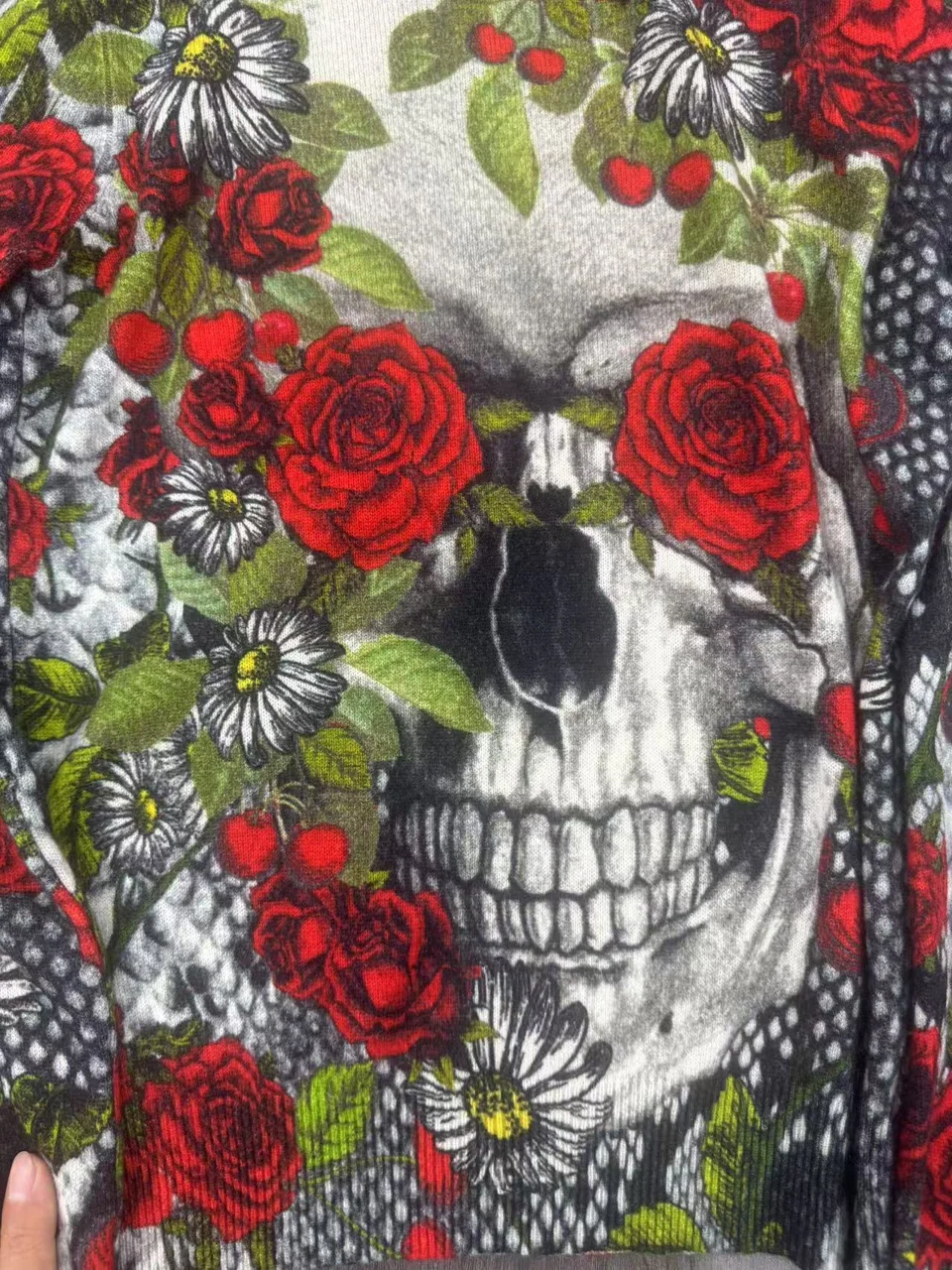
The skull's eye sockets, teeth, rose petals and daisy centres contain relatively small visual details. If the printing process is not properly matched to the knitted surface, the printed edges may appear less defined or colours may spread beyond their intended boundaries.
Pretreatment also needs to be carefully evaluated.
Insufficient pretreatment may affect ink interaction and colour reproduction, while an unsuitable or excessive treatment may change the natural hand feel of the cashmere fabric.
Our development approach is to prepare actual 14GG cashmere knitdowns and test representative artwork sections before proceeding with the complete garment.
The skull, floral motifs and darker background areas should be assessed separately because each contains different levels of detail and colour coverage.
The objective is to achieve an appropriate balance between image definition and the natural surface character of cashmere.
3.2 Reproducing Deep Black and Rich Red Colours
This design depends heavily on colour contrast.
The black and grey artwork needs to retain visible tonal differences rather than becoming a single flat dark area.
The red roses require clear separation between deeper red and brighter red tones, while the green leaves need to maintain their natural visual character.
Colour appearance on a monitor cannot be used as the final approval reference.
The actual result depends on the knitted substrate, pretreatment, ink system, printing conditions and fixation process.
Our development approach includes colour calibration and physical print evaluation on the actual cashmere fabric.
The approval process should focus on the skull's black-and-white contrast, the tonal depth of the roses and the separation of the smaller floral details.
The physical printed sample is the reference for colour approval, not the original RGB artwork alone.
3.3 Maintaining Artwork Proportions on an Elastic Knitted Structure
Unlike conventional woven fabric, knitted fabric has natural elasticity and can change dimensions during preparation, printing, fixation and washing.
This is particularly important for a design with a large central image.
If the knitted fabric changes dimensions during processing, the skull may appear wider, narrower or differently positioned than intended.
The same issue can affect the alignment of the artwork around the shoulders, sleeves and neckline.
Our approach is to establish the dimensions and placement references before printing.
The front, back, left sleeve, right sleeve and neckline should have clearly defined artwork positioning information.
For different garment sizes, the skull and surrounding floral arrangement should be reviewed individually.
Simply enlarging or reducing the same artwork proportionally may not preserve the intended visual balance across all sizes.
Size-specific artwork placement is therefore an important part of engineered print development.
3.4 Preserving Cashmere Softness After Printing
This is one of the most important quality considerations in the entire project.
Customers purchasing a 100% cashmere sweater expect a soft, lightweight and comfortable wearing experience.
A print that looks attractive but makes the knitted fabric noticeably stiff or harsh would not meet the intended product requirements.
The final hand feel depends on several connected factors, including pretreatment, ink chemistry, fixation and washing.
For cashmere, these conditions cannot simply be copied from a conventional cotton printing process.
The selected printing system needs to be evaluated using actual cashmere knitted swatches.
Particular attention should be given to the balance between colour intensity, print definition and the original softness of the fabric.
Our priority is to preserve the natural qualities of the cashmere rather than pursuing maximum colour saturation at any cost.
If a printing option produces stronger colours but creates an unacceptable change in hand feel, the artwork or printing conditions should be reconsidered.
VIAKNIT's Development Process: From Cashmere Knitdown to Finished Garment
The development process is divided into five stages.
Stage 1 — 14GG Cashmere Knitdown
The first stage is to produce a plain jersey knitted swatch using the actual 100% cashmere yarn intended for the project.
The construction is based on 14GG in a fine-gauge knitting structure.
The development team should record the swatch weight, dimensions, stitch density, elasticity and surface characteristics.
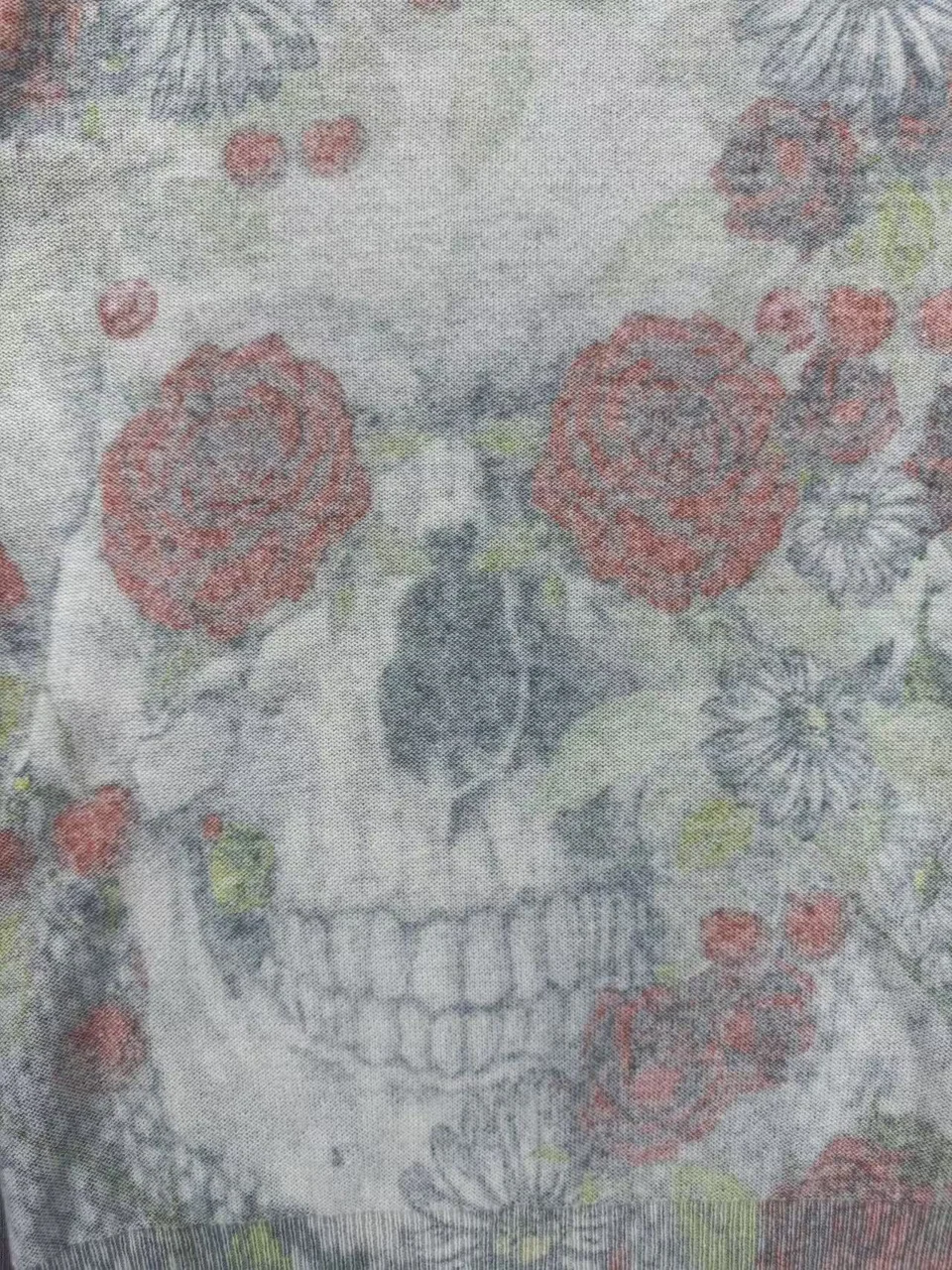
An unprinted cashmere swatch should also be retained as a control sample.
This is important because the printed fabric needs to be compared with the original material to evaluate any changes in softness, appearance and dimensions.
Stage 2 — Digital Print Swatch Development
Representative sections of the artwork are prepared for printing trials.
The test areas include the skull, roses, daisies and dark grey textures.
The main evaluation points are colour reproduction, edge definition, print coverage and changes in surface hand feel.
The purpose is to identify a suitable printing direction before applying the artwork to the complete garment.
The actual cashmere knitdown remains the primary development reference throughout this stage.
Stage 3 — Fixation and Washing Evaluation
After printing, the selected ink system requires an appropriate fixation process.
For printing systems based on acid dye inks, fixation commonly involves controlled steaming, followed by washing to remove unfixed dye.
However, the actual process must be determined according to the ink supplier's technical requirements and the cashmere substrate.
Cashmere should not automatically follow standard cotton washing conditions.
The printed swatches need to be evaluated for colour fastness, surface appearance, hand feel and dimensional changes.
The unprinted control swatch provides a useful comparison when assessing the effects of the printing and finishing process.
Stage 4 — Complete Garment Printing and Prototype Review
After the printing direction has been evaluated, the approved artwork is applied to the complete garment.
For this project, the selected approach was Garment Printing rather than conventional Panel Printing.
The sweater was first assembled, after which selected joining areas were opened to allow the garment to be positioned for printing.
The initial sewing used white cotton thread.
This construction detail is important because the garment needs to be prepared for printing while retaining the ability to be handled and subsequently reassembled.
Where elastic yarn is incorporated into the cuffs or hem to maintain stretch, colour-matched elastic yarn should be used.
Using an unsuitable contrasting elastic yarn can create visible colour differences in the finished garment.
After printing, the garment construction and finishing need to be checked together.
The main inspection points include the central skull position, floral placement, shoulder transitions, sleeve artwork, turtleneck and overall garment dimensions.
Stage 5 — PP Sample and Bulk Production Preparation
Before bulk production, the final artwork file, colour references, yarn specifications, size measurements and finishing conditions need to be confirmed.
The PP sample should represent the intended production construction, including the selected garment printing method and relevant finishing details.
The customer should approve the physical sample before the bulk production stage is released.
The approved sample then provides the reference for subsequent production and quality control.
This is particularly important for printed cashmere because changes in printing conditions, garment preparation or finishing can affect both the appearance and hand feel of the final product.
Panel Printing vs. Garment Printing: Which Method Is More Suitable?
One of the most important technical decisions in this project was the choice between printing individual knitted panels and printing the assembled garment.
Both methods can be considered for digitally printed knitwear, but they involve different production requirements.
| Consideration | Panel Printing | Garment Printing |
|---|---|---|
| Printing Stage | Before garment assembly | After garment assembly |
| Printing Surface | Individual knitted panels | Complete garment positioned on a printing platform |
| Artwork Placement | Controlled on separate panels | Coordinated across the assembled garment |
| Seam Alignment | Requires pre-planned artwork matching | Can accommodate artwork intended to cross garment sections, subject to platform and positioning limitations |
| Handling | Easier access to individual flat panels | More complex garment positioning and handling |
| Main Consideration | Matching artwork across joining seams | Garment fixation, placement and handling |
| Development Requirement | Accurate panel templates | Suitable garment positioning and printing setup |
Why Was Garment Printing Selected for This Project?
The artwork was designed as a complete visual composition rather than a simple collection of independent printed panels.
The central skull, surrounding roses and continuing dark textures needed to be considered as parts of one garment design.
The selected Garment Printing method allowed the development team to approach the artwork as a complete garment placement.
However, garment printing involves more complicated positioning and handling.
The assembled garment must be positioned appropriately on the printing platform, and the relevant joining areas must be prepared to accommodate the printing operation.
The actual process needs to be confirmed with the printing equipment and supplier.
For this project, the selected approach also required attention to the original white cotton sewing thread and the colour of any elastic yarn incorporated into the cuffs and hem.
These details are important because printing is only one part of the finished garment construction.
VIAKNIT's Key Technical Decisions
The development direction was established around the following technical considerations.
| Development Area | Technical Direction | Main Consideration |
|---|---|---|
| Gauge | 14GG | Fine-gauge cashmere construction |
| Fibre | 100% Cashmere | Preserve natural cashmere characteristics |
| Construction | Plain Jersey | Relatively even surface for printing |
| Printing | Digital Inkjet Printing | Complex images and colour transitions |
| Ink | Evaluate Acid Dye Ink first | Compatibility with protein fibres |
| Artwork | Engineered Placement Print | Accurate skull and floral positioning |
| Finishing | Controlled Steaming and Gentle Washing | Fixation and removal of unfixed dye |
Why Evaluate Acid Dye Ink for Cashmere?
Cashmere is a protein-based natural fibre.
Acid dye systems are used in textile printing applications involving protein fibres such as wool, silk and cashmere.
They are therefore an important printing option to evaluate for this type of project.
However, not every acid dye ink system is automatically suitable for every cashmere knitted structure.
Ink compatibility, pretreatment, fixation and washing conditions need to be confirmed with the printing supplier.
The process should be evaluated on the actual 14GG cashmere fabric rather than relying on general printing specifications developed for other materials.
Why Use Plain Jersey as the Printing Base?
The main body uses plain jersey construction.
Compared with more textured knitted structures, plain jersey provides a relatively even surface for reproducing complex printed artwork.
This is particularly useful for detailed illustrations, colour gradients and photographic-style graphics.
Nevertheless, the natural cashmere halo remains a factor in print definition.
The actual surface needs to be evaluated through physical printing trials.
Why Is Engineered Placement Printing Important?
This artwork has a clear visual centre.
The skull needs to remain in the centre of the front body, while the roses and surrounding floral elements must maintain their intended positions.
The sleeves and neckline also need to continue the overall visual theme.
For this reason, the artwork should be developed as a set of garment-specific placement files rather than a single image applied without reference to garment measurements.
The front, back, left sleeve, right sleeve and neckline should each have their own positioning references.
For different sizes, artwork proportions and placement need to be reviewed to maintain the intended design balance.
Quality Control: What Needs to Be Verified Before Production?
For a premium digitally printed cashmere sweater, quality evaluation needs to cover the knitted material, printing result, garment construction and finishing.
| Inspection Area | Main Evaluation Criteria |
|---|---|
| Fibre Composition | Verification of 100% Cashmere |
| Knitting Gauge | 14GG |
| Fabric Construction | Plain Jersey |
| Print Definition | Clarity of skull and floral details |
| Colour Reproduction | Black, grey, red and green colour consistency |
| Print Placement | Artwork positioning across garment sections |
| Hand Feel | Comparison with unprinted cashmere control swatch |
| Colour Fastness | Appropriate testing for the selected ink system |
| Dimensional Stability | Measurements before and after processing |
| Garment Construction | Neckline, sleeves, cuffs and hem |
| Elastic Yarn | Colour coordination where elastic yarn is incorporated |
The final evaluation should use the actual printed garment and the agreed testing conditions.
For colour fastness, suitable testing methods should be selected according to the printing system and intended care requirements.
The garment should also be checked for visible colour changes, bleeding, loss of detail and unacceptable changes in fabric hand feel after washing.
No single printing parameter can guarantee the final result without actual material and process evaluation.
What Designers Should Consider Before Developing Digital Print Cashmere Knitwear
Digital printing creates opportunities for more complex and visually distinctive cashmere knitwear.
However, the design needs to be considered together with the material and printing process from the beginning.
Before development, designers should prepare high-resolution original artwork and identify the intended image placement across the garment.
The artwork should be separated into the front body, back, sleeves and neckline where necessary.
The cashmere yarn and knitting construction also need to be confirmed because the knitted surface can influence the final print appearance.
For detailed images, it is particularly important to review small features such as facial details, flower centres and narrow colour transitions on actual knitted swatches.
Designers should also consider whether Panel Printing or Garment Printing is more suitable for the intended artwork and garment construction.
Finally, the printed fabric needs to retain the original character of cashmere.
A successful development should balance visual detail, colour reproduction, softness and garment performance rather than focusing on print appearance alone.
Technical Questions
How do you reproduce detailed artwork on cashmere sweaters?
The process starts with high-resolution original artwork and garment-specific placement files.
The design should be divided into the front body, back, sleeves and neckline where necessary.
Representative print swatches are then used to assess colour reproduction, edge definition and fine details on the actual cashmere knitted surface.
Physical sample approval is important because the natural cashmere halo can influence the final appearance.
How does digital printing affect the softness of cashmere?
Digital printing can influence cashmere hand feel depending on the pretreatment, ink chemistry, fixation and washing process.
An unsuitable process may make the fabric feel stiffer or less natural.
We recommend comparing printed and unprinted cashmere swatches to evaluate changes in softness, surface appearance and fabric flexibility before confirming the printing method.
How do you test colour fastness on printed cashmere garments?
The appropriate colour fastness tests depend on the ink system, fixation method and intended garment care requirements.
Testing should be carried out on the actual printed cashmere material using suitable methods for washing, rubbing and other relevant performance requirements.
The printed sample should also be examined for colour bleeding, loss of detail and changes in fabric appearance after testing.