Engineered Openwork
Planned openings vary in scale, placement and support.
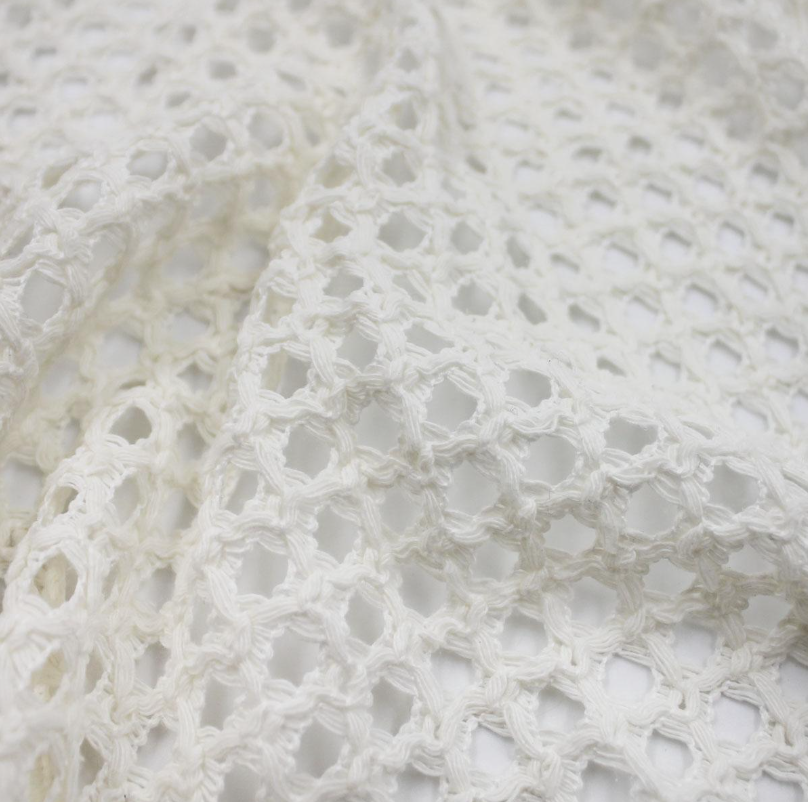
Technical Overview
Engineered Openwork refers to knitted constructions in which openings are deliberately incorporated into selected areas of the fabric.
The openings may be created through different knitting techniques, depending on the intended appearance and structural requirements.
Stitch transfer can reposition loops to create open areas. Tuck arrangements can introduce dimensional changes and controlled gaps. Miss stitches can create floating yarn sections between knitted loops. Lace constructions can combine transfers and knitting sequences to form more elaborate patterns.
Construction & Variations
Geometric Openwork
Geometric Openwork uses defined shapes such as squares, diamonds, triangles and rectangular openings.
The openings can be arranged in regular repeats or combined into larger geometric compositions.
This approach is suitable for contemporary sweaters, summer cardigans and architectural knitwear.
Mesh Openwork
Mesh Openwork creates a network of connected openings across the fabric.
Depending on the stitch construction, the mesh can be fine and compact or more open and transparent.
Tuck, miss and transfer arrangements can all contribute to mesh-like effects, although their actual structures differ.
Graduated Openwork
Graduated Openwork changes the size, spacing or concentration of openings across the fabric.
For example, a compact knitted area can gradually develop into a more open mesh section.
The reverse arrangement can also be used, with large openings gradually becoming smaller towards a solid panel.
Yarn and Gauge Considerations
Machine Gauge and Opening Size
Machine gauge influences the scale and spacing of the knitted construction.
Fine gauges can support smaller and more detailed patterns, while coarser gauges may be suitable for larger openings and more substantial mesh effects.
However, the opening size is not determined by gauge alone.
Yarn Composition and Structural Support
Wool, cotton, viscose and suitable blended yarns can all be explored for openwork development.
Wool blends may provide flexibility and a soft hand feel. Cotton blends can be suitable for summer products, while viscose blends may create a more fluid drape.
However, the suitability of a yarn depends on its strength, flexibility, surface characteristics and behaviour during stitch transfer.
Garment Applications
Localised Openwork at the Shoulder and Back
Openwork can be positioned around the upper back, shoulder or selected sleeve areas.
This introduces controlled transparency without making the entire garment too open.
The technique is suitable for summer knitwear, resort collections and contemporary women's tops.
Solid-to-Openwork Gradation
A solid knitted section can gradually transition into an openwork structure.
The transition can be achieved by changing the frequency of openings, their size or the arrangement of the surrounding stitches.
This creates a more integrated design than placing a large hole directly into an otherwise solid fabric.
Development & Quality Considerations
Weak Openwork Boundaries
The edges around large openings become stretched, distorted or damaged during wearing and washing.
Insufficient supporting stitches, excessive opening size, unsuitable yarn characteristics or concentrated tension around the boundary.
Develop a supporting stitch arrangement around the opening. Consider compact jersey, Rib, Milano or another suitable structure according to the design. Test the boundary under stretching and washing conditions.
Distortion Between Open and Solid Areas
The fabric develops waves, curling or uneven surfaces where openwork meets compact knitting.
Different loop arrangements, stitch densities, yarn consumption and relaxation behaviour.
Evaluate the two structures together rather than separately. Adjust stitch settings and transition arrangements based on physical swatches. Measure the complete panel after relaxation and finishing.
Selected FAQs
What are the different types of Engineered Openwork?
Common design directions include geometric openwork, mesh openwork, irregular openings, large-scale openwork, graduated openwork, lace-inspired structures and combinations of open and solid knitted panels.
What is the difference between Pointelle and Engineered Openwork?
Pointelle generally focuses on small, regularly repeated eyelets within a knitted structure. Engineered Openwork covers a broader range of designs, including larger openings, irregular shapes, mesh panels and planned transitions between transparent and solid areas.
What knitting techniques are used to create Engineered Openwork?
Depending on the design, manufacturers may use stitch transfer, tuck, miss, lace and other combinations of knitting actions. Each method creates a different loop arrangement and level of structural support.
Can Engineered Openwork be used for lightweight summer knitwear?
Yes. It is suitable for summer sweaters, cardigans, resort knitwear and lightweight dresses. The yarn, opening size and supporting fabric must be selected according to the desired transparency, drape and durability.
Why do large openwork areas become distorted during production?
Large openings reduce the continuity of the knitted structure. If the surrounding stitches do not provide sufficient support, the openings may stretch, become irregular or distort after washing. Boundary construction, yarn properties and finishing conditions must therefore be checked during development.
How can manufacturers improve the stability of Engineered Openwork?
Manufacturers can review the opening dimensions, surrounding stitch arrangement, yarn selection and transition between open and solid areas. Supporting structures may be introduced where necessary. Physical trials should include stretching, washing and finished garment inspection.
Develop with us
Have a detail
in mind?
Share a reference, a material or an effect you would like to explore. We can help develop a direction for your knitwear.
Discuss Your ProjectExplore our development process ↗