Double Knit / Interlock
Two needle beds form interlock and other double-faced fabrics.
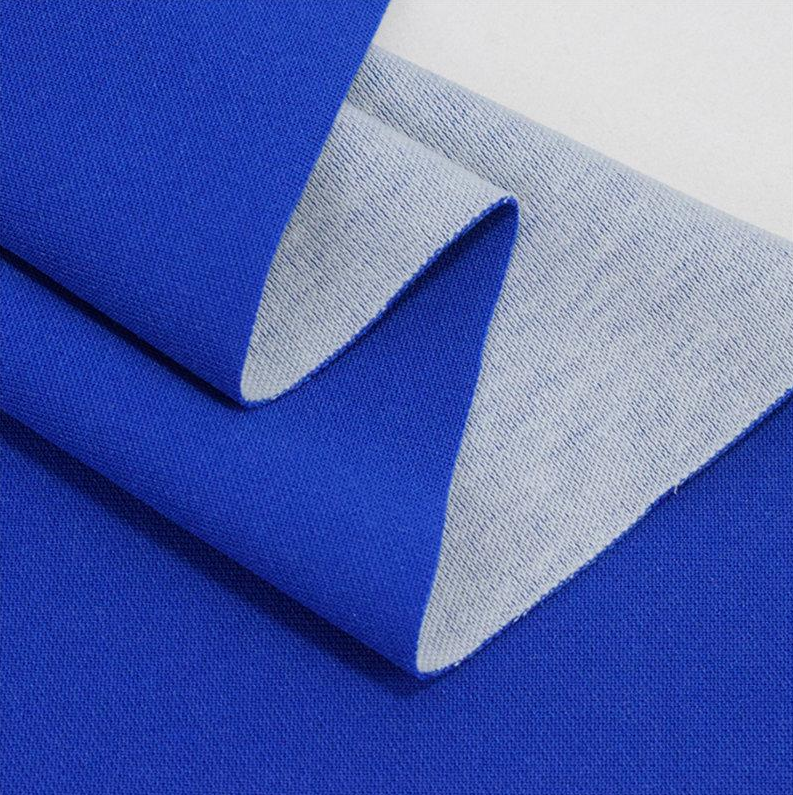
Technical Overview
Double Knit is a general term for knitted constructions that use two needle beds to create interconnected or coordinated fabric structures.
Unlike Single Jersey, which is formed on one needle bed, double-knit constructions use both the front and back needle beds.
This allows the fabric to develop a more balanced structure, with loops formed on both sides.
Construction & Variations
Interlock Knit
Interlock is a specific double-knit construction produced through two intermeshing sets of loops.
It is commonly described as two 1×1 rib structures knitted together in an interlocking arrangement.
The front and reverse sides both display a smooth technical face, with the loop wales aligned and locked together.
Double-Face Knit
Double-Face Knit refers to constructions in which the two surfaces are deliberately developed as separate visual or functional faces.
The two sides may use different colours, stitch arrangements or yarn characteristics.
For example, one side can be ivory and the other beige, or one side can be smooth while the other contains a textured stitch arrangement.
Layered Double Knit
Layered Double Knit uses two knitted surfaces connected at selected points or through a defined knitting arrangement.
Depending on the construction, the fabric may have more distinct inner and outer layers than a conventional Interlock.
The space or connection between the layers can be used to explore insulation, texture and functional yarn combinations.
Yarn and Gauge Considerations
Machine Gauge and Structure Selection
Machine gauge influences the size and spacing of the knitted loops.
Finer gauges can be suitable for lightweight and compact double-knit fabrics, while coarser gauges can be used for more substantial constructions.
However, gauge alone does not determine fabric weight or thickness.
Yarn Composition
Wool, cotton, cashmere, viscose and suitable blended yarns can be considered for double-knit products.
The choice depends on the intended hand feel, drape, thickness and garment application.
For double-face constructions using different yarns on each side, the materials should have compatible knitting and finishing characteristics.
Garment Applications
Contrasting Front and Reverse Textures
Instead of changing the colour, designers can develop different textures on the two sides.
For example, the outer face may remain smooth while the reverse contains a fine rib or selected tuck structure.
This creates a more subtle visual difference and allows the garment to retain a restrained colour palette.
Interlock for Clean, Structured Basics
Interlock can provide a smooth and compact surface on both sides.
This makes it suitable for garments that require a clean appearance without obvious differences between the front and reverse.
Applications include knitted shirts, premium tops, lightweight sweaters and selected base layers.
Development & Quality Considerations
Uneven Tension Between the Two Sides
One side becomes tighter than the other, causing the fabric to curl, bow or distort.
Differences in yarn feeding tension, stitch length, needle-bed settings or yarn characteristics.
Check the feeding conditions on both needle beds. Compare the stitch formation and fabric density on each side. Relax the sample before assessing its balance and adjust the knitting settings according to the actual yarn.
Excessive Fabric Thickness and Weight
The finished fabric becomes too heavy or stiff for the intended garment.
Yarn count, stitch length, fabric density and the number of knitted layers or backing connections.
Evaluate yarn count and stitch length during development. Compare suitable double-knit constructions and measure the finished fabric weight and thickness. Do not select a structure based only on its appearance.
Selected FAQs
What is Interlock Knit?
Interlock is a specific double-knit structure formed by intermeshing two sets of rib loops. Both sides show a smooth technical face, producing a compact fabric that generally lies flat without the curling associated with Single Jersey.
What is the difference between Double Knit and Interlock?
Double Knit is the wider category of two-needle-bed knitted constructions. Interlock is one specific construction within that category. Other double-knit structures can have different needle arrangements, surface appearances and fabric properties.
What is the difference between Interlock and 1×1 Rib?
Both use two needle beds, but their loop arrangements differ. Conventional 1×1 Rib has alternating face and reverse wales and provides greater widthwise stretch. Interlock intermeshes two rib structures, producing a more compact and stable fabric with less widthwise extensibility.
Can Double Knit be used for reversible garments?
Yes, selected Double-Face constructions can be developed for reversible garments. However, the two surfaces, seams, openings, labels and finishing must all be designed for reversible use. Not every double-knit fabric is automatically reversible.
Why is Double Knit sometimes too thick or heavy?
The two needle beds can create additional knitted material, increasing thickness and weight. Yarn count, stitch length, fabric density and layer arrangement all influence the final result. The construction should be developed according to the intended garment weight and hand feel.
How can manufacturers prevent Double Knit from curling or distorting?
The two sides must have balanced yarn feeding, stitch formation and finishing conditions. Physical samples should be relaxed and measured before and after washing. The appropriate settings depend on the actual yarn and construction.
Develop with us
Have a detail
in mind?
Share a reference, a material or an effect you would like to explore. We can help develop a direction for your knitwear.
Discuss Your ProjectExplore our development process ↗